FROM THE ART OF THE MOVIES JOURNAL
The Omen at 50: Why Richard Donner’s Horror Classic Still Scares

I spent a spell in Prague in the mid-2000s, back in the days when you never knew which film set you’d stumble onto next in the city. On one such occasion, a friend and I accidentally wandered into the background of Van Helsing and upset Hugh Jackman by interrupting a scene — he looked like he wanted to take us out with his steampunk crossbow.
By 2005, another mate told me that a remake of The Omen was getting under way at the city’s famous Barrandov Studios. He said there were some bit parts up for grabs, so why not go along and try our luck? But I turned down the idea. I had loved Richard Donner’s original ever since it scared the pants off me as a kid, and I refused to have anything to do with a new version. Sadly, my small act of boycott against the Hollywood remake machine had little impact — John Moore’s film was still a box office hit despite mostly terrible reviews.

Roger Ebert was one of the few major critics who actually gave the thing a positive write-up. Indeed, he gave the remake a higher rating than the original. Now, I’m a long-time admirer of Ebert’s work, but he sometimes had a blind spot when it came to horror movies.
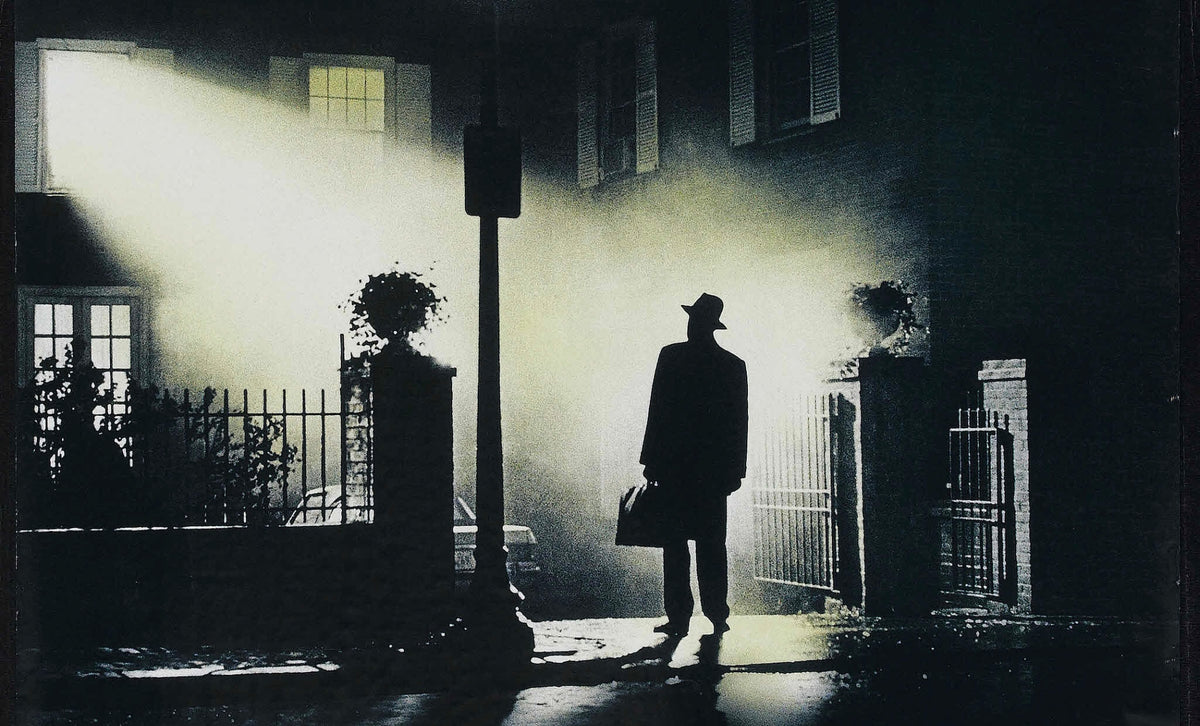
In his review of the 1976 film, Ebert inevitably name-checked Rosemary’s Baby and The Exorcist. Without the outrageous success of the latter, there might not even be The Omen. William Peter Blatty’s novel was a bestseller and there was a huge amount of hype leading up to William Friedkin’s film adaptation ahead of its release on 26th December 1973. Producer Harvey Bernhard decided he wanted something similar, handing an idea for a story involving the Antichrist over to screenwriter David Seltzer to flesh out into another money-spinning religious-themed horror.
It took Seltzer a year to come up with the goods, by which time The Exorcist had become a proto-blockbuster and cultural phenomenon. It rode a wave of controversy with accusations of blasphemy by religious groups and tales of people vomiting and passing out in theatres, which drove even more people to experience it for themselves. Consequently, Friedkin’s film was a smash hit and became the first horror movie to receive an Oscar nomination for Best Picture. Sadly, The Exorcist lost out to George Roy Hill’s enjoyable but lightweight The Sting, but it was popular enough to inspire a string of similarly themed flicks tapping into the occult and religious dread. Of these, The Omen was by far the best.

Ebert’s comparison with Rosemary’s Baby was also apt, because in many ways The Omen feels like a continuation of that story. Roman Polanski’s earlier film followed Mia Farrow’s character as she is impregnated by Satan and gives birth to his child. In David Seltzer’s screenplay, we find out what happens next, particularly to the people who try to stop the Devil’s spawn before he gets old enough to do too much damage.
Seltzer had previously worked in documentaries and saw screenwriting as a chance to learn as well as pay the bills. When he was given the job, he realised that he’d never read the Bible before and dived right in, approaching it like he was tackling Shakespeare — “I love the mythology and the characters.” He was particularly struck by the notion of the Beast rising from the eternal sea and the number 666, working those ideas into a story about an “innocent evil” growing up in a family that could potentially lead him all the way to the White House.

The Omen begins in Rome at 6 a.m. on the 6th day of the 6th month as American diplomat Robert Thorn (Gregory Peck) rushes to hospital where his wife Katherine (Lee Remick) has just delivered a stillborn child. Afraid that she will be unable to cope with the loss, Thorn takes the advice of a shady priest and switches out his dead little one for an orphaned baby boy born at exactly the same time.
It’s one of several dubious decisions made by Thorn throughout the film, but that’s where the casting works so well: Gregory Peck often portrayed noble characters with strong morals, so who are we to question the guy who played Atticus Finch in To Kill a Mockingbird? His grave presence grounds the movie, and I’m not sure if it would’ve played so well with some of the other potential casting choices.
Charlton Heston, William Holden — who turned it down but would star in the sequel — Charles Bronson, Roy Scheider, and even Dick Van Dyke were all considered to play Thorn before Peck got the part. Warner Bros. wanted Oliver Reed, who had given the performance of his career a few years earlier in The Devils — a bit rich since the studio butchered Ken Russell’s masterpiece and is still sitting on the Director’s Cut to this day.
Back to the movie, and we skip forward five years to learn that Thorn has been promoted to Ambassador to the United Kingdom. The baby, named Damien, has grown into a creepy-looking boy with piercing eyes and the smile of a tainted cherub, played with unsettling believability by Harvey Spencer Stephens in his only major screen role, apart from a cameo in the remake. Thorn moves the family to a big old mansion near London and everything seems hunky-dory until menacing rottweilers start lurking around the estate and Damien’s young nanny inexplicably hangs herself at his birthday party.

The horrific public suicide is the first in a series of breathtaking death sequences in the film, and it leaves the Thorn family in a bit of a predicament. Apparently, a diplomat’s wife like Katherine can’t be expected to look after Damien on her own, so they’re relieved when a replacement, Mrs. Baylock (Billie Whitelaw), shows up uninvited on their doorstep. They don’t see anything unusual about this and recruit her on the spot. She’ll definitely take good care of the kid, however — turns out she’s one of Satan’s minions and will do anything to protect him.
Other strange stuff starts happening. Damien throws a violent tantrum in the vicinity of a church and the animals at a safari park go bananas in his presence. Thorn is approached by Father Brennan (Patrick Troughton), a terrified priest who claims he was present at Damien’s birth and that the boy is none other than the son of Satan.
Thorn initially dismisses Brennan as a nut, but the priest knows enough to give him pause. During a second meeting, Brennan insists that the child must be killed before it’s too late. That’s the final straw for Thorn, and also for the powers of darkness. Brennan dies in a freak accident, impaled by a lightning rod falling from a church roof in a sudden storm.

Also hanging around is Keith Jennings (David Warner), a rakish photographer who was present at the birthday party and also took some snaps of Brennan before his death. This is where The Omen really kicks into gear with a neat Twilight Zone-esque plot device: when developing his photos of Brennan and the ill-fated nanny, he discovers sinister lines on the images that look disturbingly like a rope around her neck and a pole piercing the priest’s shoulder.
In the meantime, Katherine has miscarried another child after she is “accidentally” knocked off a balcony by Damien. Now Thorn is starting to take Brennan’s warning seriously, and Jennings reveals that he also has skin in the game. While taking photos in the priest’s grim bedsit, he inadvertently captured a shot of himself in the mirror…
Gregory Peck and Lee Remick are the big star names up front, but it’s the British contingent within the cast that makes all the religious hocus-pocus of The Omen hit so hard. Patrick Troughton, the second actor to play Doctor Who on television, looks palpably terrified as the doomed priest who knows too much. Billie Whitelaw is wonderful as the demon nanny, with her gentle eyes and soft lilting Irish voice radiating kindness until the mask slips and we see the deranged cultist beneath.
Best of all is David Warner as Jennings. His calm demeanour and reserved friendliness counterpoints Brennan’s panicky ravings nicely, which is maybe why Thorn instinctively trusts him. In his cravat and blazer, we can perhaps imagine him taking snaps of the Fab Four and Jimi Hendrix down Carnaby Street a few years before. Now he’s caught up in a satanic conspiracy and keeps a stiff upper lip despite the daunting odds.

Jennings and Thorn form an unexpected buddy dynamic as they head off on a road trip to Italy and Israel to find out Damien’s true origins and learn how to kill him in the correct way. This is where we meet the redoubtable Rumpole of the Bailey star Leo McKern in a small but crucial role as Bugenhagen, an archaeologist who has just the tonic. He gives Thorn seven ceremonial daggers that must be used to slay Damien on consecrated ground.
Even with all evidence pointing to Damien really being the Antichrist, Thorn still can’t handle the thought of stabbing a child to death. With his neck literally on the line, Jennings resolves to take care of it himself, and seals his fate in the most decisive and gruesome manner.

A Hungarian movie poster for The Omen
I’ve seen The Omen maybe a dozen times over the years, and Jennings’ death still leaves me gasping. We know what’s coming from the moment Jennings shows Thorn the photo of himself revealing a sharp line across his throat. That anticipation only heightens the film’s sense of foreboding, and it’s still a big shock when the moment comes.
After Thorn throws the daggers away into a building site, Jennings hurries to retrieve them. While he is preoccupied, a workman accidentally knocks the handbrake off his truck, sending it trundling down the hill towards the Brit. Jennings looks up, but too late — the truck hits an obstacle and a sheet of plate glass hurtles off the back, decapitating him and sending his head tumbling through the air.
Richard Donner obviously knew this was the money shot and he treats it that way. While the deaths of the nanny and the priest are short, sharp, and nasty, the director really goes to town with the unfortunate photographer’s demise. With Jerry Goldsmith’s score reaching a shrieking crescendo, we see Jennings’ head separated from his shoulders no less than six times from different angles in the space of three seconds, a superb piece of editing that accentuates the sheer brutality of his death. As a final ghastly touch, the disembodied head comes to rest gazing into another pane of glass, echoing the mirror earlier in the film — maybe Jennings is still conscious enough to realise with utter horror that the premonition has come to pass.
The inevitability of Jennings’ death is the culmination of the ominous dread that Richard Donner patiently builds up until that point. If all this is foretold, what possible hope does humanity have in the face of age-old evil? We’d have to wait until Omen III: The Final Conflict to find out, but for now the grisly and undignified end of the movie’s most likeable character tells us this one isn’t going to have a happy ending.
The film was a sizeable hit at the box office, grossing over $60 million against a $2.8 million budget, and two sequels followed. Damien: Omen II really leaned into the freak death angle but, with Richard Donner and David Seltzer absent, the increased body count never had the same visceral impact. Nevertheless, the first two movies of the original Omen trilogy are seen as precursors to the Final Destination franchise, in which a supernatural force concocts ever-more elaborate deaths for its hapless victims.
Outside of the horror genre, The Omen is such an enduringly popular film that its influence can be found in the most unlikely places — Martin Freeman’s character in The World’s End is nicknamed “O-Man” due to his birthmark, and British readers will no doubt remember the running joke in Only Fools and Horses when Rodney worries that his nephew Damien might be the Antichrist.

A Polish movie poster for The Omen
Comedy associations aside, The Omen has lost little of its chilling power. “Everything’s scary if you turn down the lights and play the right music,” David Seltzer said once in an interview, and that’s certainly the case even now. Jerry Goldsmith’s Academy Award-winning score — the only Oscar of his career, incidentally — sets the mood with its baleful Latin chants and, although I’d say The Exorcist is the better film overall, Donner’s fright moments have aged better.
Linda Blair’s rotating head and pea-soup upchucking look almost comically dated nowadays compared to the understated theological fear of the rest of the movie, while the sparing death sequences in The Omen feel more plausibly grounded in reality, even when fate starts arranging things with a distinctly Heath Robinson-like sense of cruelty. Now 50 years old, it’s still as scary as hell.
Fifty years on, The Omen remains one of the great studio horror films of the 1970s: polished, portentous and still capable of making the hairs stand up. Its poster campaign understood that power perfectly, turning three simple numbers — 666 — into one of cinema’s most ominous pieces of graphic shorthand.
You can explore our current original horror movie posters here.