FROM THE ART OF THE MOVIES JOURNAL
Stanley Kubrick’s Early Films: Fear and Desire, Killer’s Kiss and The Killing

2026 marks my fifth year writing for the Art of the Movies blog! While I’ve touched upon Stanley Kubrick’s work in several articles, it only recently occurred to me that I’ve never written about any of his films specifically. So, to fix that oversight, I decided to sit down and watch all 1631 minutes of his filmography in chronological order…
Kubrick only made 13 feature films over a career spanning almost half a century. In a way, it feels like even fewer because his two earliest pictures are only really the domain of scholars and Kubrick completists, and a whopping 12 years elapsed between Full Metal Jacket and his final film, Eyes Wide Shut.
Nevertheless, Kubrick’s relatively slender filmography has established him as one of the most revered directors of all time, standing alongside the likes of Hitchcock, Kurosawa, Bergman, Spielberg, Scorsese, and Welles. Even among that company he was unique, an art-house visionary who was able to work successfully within the studio mainstream, matching ambition with commercial nous and crafting several all-time classics that are as iconic as they are meticulous and intellectually rigorous.
For an idiosyncratic film-maker with lofty ideals, Kubrick was also a consummate genre-hopper with a shrewd eye for source material. Indeed, every one of his films from The Killing onwards was an adaptation, in most cases transforming other writers’ works into something distinctly his own. Just ask Stephen King, who famously hated The Shining!
But for all his status as one of cinema’s greatest directors, Kubrick made a slow start…as I found out when I watched Fear and Desire and Killer’s Kiss for the first time.
Fear and Desire (1952)
Even legendary film-makers have to start somewhere. Kubrick was just 24 when he made Fear and Desire with just a few short documentaries under his belt, going all-in by quitting his job as a photographer for Look magazine and borrowing $10,000 from his uncle to shoot the film in California’s San Gabriel Mountains.
On paper, it has solid credentials, written by Kubrick’s old classmate Howard Sackler who would later win a Pulitzer Prize for The Great White Hope. As a self-financed project, Kubrick also didn’t need to worry about studio interference as he produced, directed, shot, and edited the film himself, no doubt picturing himself as the next Orson Welles.

As some people have rather cruelly pointed out, Fear and Desire is more in the realm of that somewhat less successful multi-hyphenate film-maker of the ‘50s, Edward D. Wood Jr, than the maverick genius behind Citizen Kane. That might be stretching the point a little, but the limited resources and the greenness of Kubrick and Sackler at that stage of their careers is all too apparent.
After a contrived opening monologue that takes great pains to point out that the film is an allegory rather than a story about a real war, we pick up with four servicemen from an unidentified country who have crash landed six miles behind enemy lines. In charge is the suave and ironic Lieutenant Corby (Kenneth Harp), who quickly hatches a plan to build a raft and drift back to safety along the river. The most immediate challenge to his authority appears to come from Sergeant Mac (Frank Silvera), a blue-collar stiff back in the real world who sees a shot at heroism when he spies an enemy general (also played by Harp) based in the vicinity.
We get a lot of walking around in the woods in this movie, belying the limited budget. In one shot, you can even see passing traffic in the distance – something that the notoriously obsessive Kubrick wouldn’t have tolerated in his later and better-financed films. Further danger arises when the gang are spotted by an attractive young peasant girl (Virginia Leith), who proves too much of a temptation for fragile-minded rookie Private Sidney (Paul Mazursky) when he’s left watching the captive.
Fear and Desire is a really tough watch. Apart from a few nicely framed shots and some good close-ups, there is little to distinguish it from other B-grade men-on-a-mission flicks of the era. The photographer’s eye of Kubrick is apparent, but he evidently struggled with the constraints of low-budget film-making, resulting in choppy editing and continuity. Even so, he still showed early signs of innovation that would become a hallmark of his pictures, such as improvising tracking shots using a baby carriage.

Where the film really falls down is with the dialogue and performances. Sackler’s screenplay strives for profundity, but its philosophical musings come across as a little Ed Wood-ian due to the inept delivery by the low-rent cast. Worst of all is Mazursky, who would go on to become an Oscar-nominated film-maker of some repute (Bob & Carol & Ted & Alice; Harry and Tonto). His performance as the greenhorn who cracks up alarmingly fast is very am dram. The best turn in the film comes from Virginia Leith, now best known for her role as the disembodied head in The Brain That Wouldn’t Die – perhaps she stands out because she doesn’t have any turgid lines to recite.
Stanley Kubrick himself was arguably the harshest critic of Fear and Desire. He later dismissed it as a “bumbling amateur film exercise” and tried his hardest to wipe the film from existence. After the film’s distributor, Joseph Burstyn, died, the film fell out of circulation, and Kubrick later tried to suppress it as far as he could.
Frankly, it wouldn’t be a great loss to cinema if he’d succeeded. But if you’ve got the fortitude and an hour to spare, Fear and Desire is interesting if only as a yardstick to measure Kubrick’s incredible rate of development. By 1957, he would release his first truly great film, Paths of Glory, and you can see the seeds of that picture here, although the difference in execution is vast.
Killer’s Kiss (1955)
Returning to his native New York City, Kubrick was on far surer footing for his second feature. As a result, Killer’s Kiss is a far more accomplished film all round apart from one aspect – the storytelling.
The plot is bog standard pulp. Jamie Smith plays Davey Gordon, an over-the-hill prize fighter who falls for Gloria (Irene Kane), a forlorn dancer who lives across the courtyard in his apartment building. The pair meet and quickly fall in love, which doesn’t go down at all well with Gloria’s boss and small-time gangster boyfriend Vincent (Frank Silvera, returning from Fear and Desire). You can probably guess the rest.

The story and the dialogue are so prosaic that Howard Sackler didn’t even get a screenwriting credit this time. It’s almost as if Kubrick picked film noir as a handy sandbox for the visual style he was developing - and visually, Killer’s Kiss is leaps and bounds ahead of his debut.
Shooting on the fly without a permit, Kubrick’s high-contrast black-and-white photography offers an atmospheric snapshot of New York in the mid-’50s as the story moves from the old Penn Station and Times Square to the sooty tenements of Brooklyn and SoHo. The film-making is far more confident with some imaginative shots and nicely composed images as the tepid narrative eventually builds to a rooftop chase and a surprisingly forceful final boss fight in a mannequin factory.

It’s just a shame that Kubrick didn’t spend a bit more time trying to tell a compelling story with interesting characters. Smith and Kane are bland leads and the bare-bones nature of the plot makes the pacing drag, falling well short of gripping film noir classics from around the same time like Pickup on South Street and Kiss Me Deadly.
The overall impact of the tale was further hampered by a rare instance of studio interference in Kubrick’s career. In exchange for a $100,000 cheque and a further $100,000 towards his next film, United Artists insisted on a tacked-on happy ending. That’s a big no-no for film noir and it totally dilutes the usual sense of fatalism associated with the genre, but there was a plus side: Kubrick put that money to good use and made The Killing.
The Killing (1956)
Phew, that was a slog! But one of the most rewarding things about watching Kubrick’s movies back-to-back is arriving at The Killing after suffering through his first two range-finders. This is where you really see it all coming together, with Kubrick not only showing great control of all the moving parts but also developing his voice as a film-maker.
Sterling Hayden, already a tough guy veteran of numerous westerns and crime flicks, plays Johnny Clay, an ex-con who puts together a motley crew of ageing chancers for a callous racetrack robbery. Johnny’s scheme hinges on each man hitting his mark at exactly the right time, but the plot quickly unravels thanks to loose lips, misfortune, and double-crosses.

Adapted from Lionel White’s novel Clean Break by hard-boiled fiction writer Jim Thompson (The Killer Inside Me, The Grifters), the movie was Kubrick’s first of three collaborations with producer James B. Harris. Classic Hollywood film noir was coming to the end of an era and its alluring fatalism was curdling into something even more cynical and weary. With its terse dialogue, gone-to-seed characters, and a nihilistic shrug of a last line, The Killing fits nicely into this cycle.
The story goes that Harris met Kubrick while he was playing chess in Washington Square Park, where the young film-maker sometimes hustled games to make a little extra cash in the early stages of his career. Many critics have been quick to note the similarities between chess and The Killing, which can be said of all great heist movies – the film-maker lures us in as they move the pieces around the board, letting us in on the action while hiding their true strategy until the endgame.
Kubrick plays fast and the film moves urgently forward over a brisk 84 minutes, packing in some great character work from a cast of seasoned actors along the way. There are some wonderfully grizzled mugs on display here, an assembly of interesting lived-in faces that feel familiar even if you’ve never seen them before. They all have their moments to shine, but best of all is Elisha Cook Jr. as George, a meek racetrack cashier and cuckolded milquetoast whose desire to make his gold-digging wife happy (played with superb brazenness by Marie Windsor) sets the crew’s downfall into motion.

Crisply shot and snappily edited, Kubrick demonstrates full mastery of the cleverly structured screenplay that tantalisingly reveals new pieces of information before doubling back and showing the action from a different perspective. That may sound familiar to fans of Reservoir Dogs – Quentin Tarantino has acknowledged the influence of The Killing on his debut feature.
I really like this movie and I only have a couple of nitpicks. It’s a little over-scored by Gerald Fried’s bombastic music, and the documentary-style narration is a bit intrusive. The latter was perhaps necessary to help audiences at the time keep up with the plot, because non-linear storytelling was far less of a thing back then.
Overall, The Killing is miles better than the first two movies, and Kubrick considered it as the true start of his film-making career. And of course the best was still to come, beginning with his next endeavour…
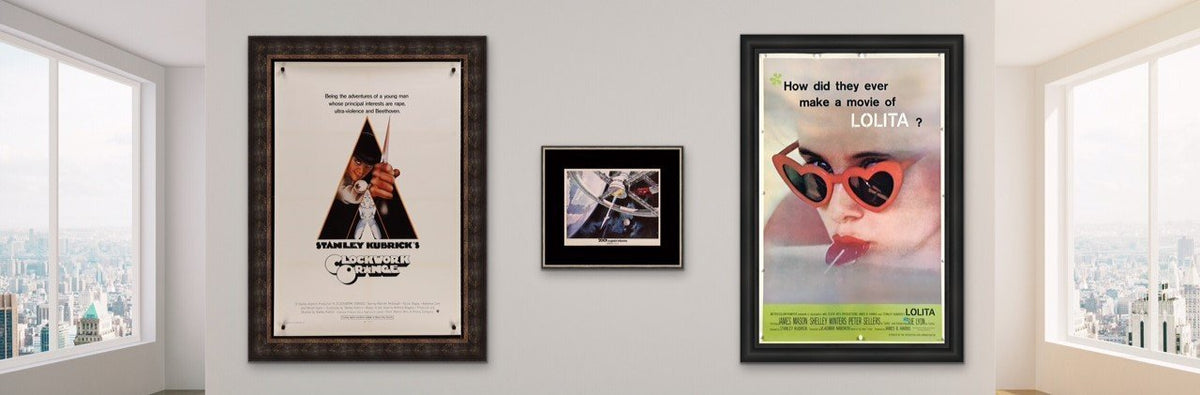
For collectors, Kubrick’s posters have a particular pull: each film carries its own visual world, from the stark and conceptual to the strange, theatrical and unsettling. You can explore our current original Stanley Kubrick movie posters here.
Stay tuned for the next part of our Kubrickathon, in which we take a look at the two films that gave the film-maker the freedom to make just about anything he wanted: Paths of Glory and Spartacus.