FROM THE ART OF THE MOVIES JOURNAL
Stanley Kubrick and Kirk Douglas: Paths of Glory and Spartacus

Continuing our series celebrating the incredible career of Stanley Kubrick, we take a look at the young director’s first major collaboration that helped him make his name in Hollywood…
With his iconic dimpled chin and piercing blue eyes, hard-driving Kirk Douglas certainly achieved a lot during his peak when he grabbed Hollywood by the scruff of its neck and didn’t let go. Known for his tenacity and commanding screen presence, he earned Oscar nominations for Champion (1949), The Bad and the Beautiful (1952), and Lust for Life (1956), and also made memorable impressions in Ace in the Hole (1951) and Gunfight at the O.K. Corral (1957). But when he reached his 100th birthday and sat down to discuss his long career, his work with Stanley Kubrick was the real hot topic:
Difficult? [Kubrick] invented the word. But he was talented. So, we had lots of fights, but I always appreciated his talent. I always said he was a bastard, but he was a talented, talented guy.
Some might suggest that this was a case of pot and kettle trading insults. Douglas was also known as a fiercely driven and tricky person to work with. Burt Lancaster, who starred in seven movies with Douglas over a period of 40 years, knew better than most:
Kirk would be the first to admit he’s difficult to work with – and I would be the second.
So when Douglas decided he didn’t want to be a Hollywood “poodle” anymore and started making films under the banner of his own production company, the stage was set for a prickly relationship between the two-fisted Hollywood legend and the idiosyncratic rising talent of Stanley Kubrick.
Paths of Glory (1957)
After the uncertain start of Fear and Desire and Killer’s Kiss, Kubrick had really found his feet with The Killing. The cynical heist thriller made a loss at the box office but it gained the favour of several critics who placed it in their Top 10 lists for the year. That generated enough attention for MGM to sign up Kubrick and his regular producer James B. Harris to make another movie from the studio’s vast pile of unused scripts and novels.
Typically for Kubrick, he wanted to go his own way. Unable to find anything that took his fancy at MGM, he recalled Paths of Glory, a 1935 novel by Humphrey Cobb that had since fallen out of print. Aided by more equipment, better financing, and significant studio backing, it would give him a chance to revisit the anti-war themes of his debut, Fear and Desire, with far more polish and craft.

The studio worried (with good reason, as it turned out) that the screenplay’s subject matter might cause distribution problems in Europe. But it also attracted the attention of Kirk Douglas, who threw his weight behind the project and persuaded United Artists to stump up the cash for the production.
Kubrick and Douglas clashed before cameras even rolled. Conscious about alienating audiences with the novel’s bleak conclusion, Kubrick and screenwriter Jim Thompson (collaborating again after The Killing) added a more upbeat ending to make the film commercially viable. Douglas flipped his lid. He’d secured the money on the basis of the original script and told Kubrick in no uncertain terms that they’d make the film his way or not at all.
Paths of Glory opens in 1916: We’re in a palatial setting as we meet Paul Mireau (George Macready), a seasoned Brigadier General of the French Army. He greets his superior, General Broulard (Adolphe Menjou), who has a job for him: To take the Anthill, a fortified German stronghold that is deemed crucial to breaking the enemy line. Mireau initially dismisses such an assault as impossible, but he swiftly changes his tune when Broulard dangles promotion as a reward.
Mireau hands over the mission to Colonel Dax (Douglas), who believes the attack would be suicidal with his beleaguered regiment in no fit state to undertake such a major operation. Nevertheless, Mireau pressures Dax into it and the assault is a disaster. The first wave gets decimated in No Man’s Land and Mireau tries to order artillery fire on his own trenches to force the remainder of Dax’s troops to join the battle. When the order is refused, the surviving soldiers retreat.
In the wake of the mission’s failure, Mireau attempts to cover his own backside by ordering the court martial and execution of 100 men to set an example. Major Broulard and Dax negotiate him down to three, selected at random from each company: Corporal Paris (Ralph Meeker, Kiss Me Deadly); Private Ferol (Timothy Carey), a “social undesirable”; and Private Arnaud (Joe Turkel), who is selected despite previous decorations for bravery. Dax, a lawyer in civilian life, is granted permission to defend the condemned men – but can he save them from the firing squad?
Over the decades, Kubrick developed a reputation as a cold, intellectual, and emotionally distant filmmaker. Paths of Glory finds him at his most humanistic, taking an impassioned stance against the self-serving military higher-ups who think nothing of sacrificing the lives of thousands of men in pursuit of their own personal glory. The class battle lines are also firmly drawn: Upper-crust career man Mireau lording it up in his chateau while the grunts hunker down in their muddy hole on the battlefield, awaiting absurd orders that might mean they never see home again.

Anti-war message aside, Paths of Glory is the first instantly recognisable Kubrickian work in the director’s filmography. Shot entirely on location in Germany with hundreds of extras and featuring the first of the director’s most memorable tracking shots, it’s a handsome-looking picture that feels far more authentic in its battlefield action than any other war movie of the period. Kubrick’s meticulous vision takes a step back during the Anthill assault, using George Krause’s crisp cinematography to take a more omniscient view of the drama.
To this end, we take a God’s eye view of the doomed mission. Naming the German stronghold the Anthill is perhaps significant – from our lofty viewpoint, Dax’s men seem like so many insects scurrying across the blasted landscape only to be cruelly snuffed from existence as the artillery shells and machine-gun fire rain down.
The sequence prefigures the Normandy landings scene in Saving Private Ryan almost 40 years later, stripping any glorification or sentimentality from the bloodshed. When Paths of Glory hit theatres, there was still a tendency for Hollywood war movies to focus on the heroism of the good guys, but Kubrick’s intended to emphasise the futility of armed conflict – indeed, the title of the film and Cobb’s source novel is clearer in its original context. Taken from Elegy Written in a Country Churchyard, an 18th Century poem by Thomas Gray, the full line sums it up: “Paths of glory lead but to the grave.”
Despite its grim subject matter, Paths of Glory is a compulsively watchable film. Clocking in at under 90 minutes, it feels epic but also moves along at a tidy pace, energised by Kirk Douglas’s forceful star turn. During the screenwriting process, Kubrick switched the emphasis from the condemned men to Colonel Dax, and Douglas commands every scene he’s in.
That said, Dax isn’t a particularly well-drawn character. He’s courageous and compassionate, but he feels more like a vessel to deliver Kubrick's anti-war message than a real person. The film’s humanity comes from the three actors playing the unfortunate soldiers preparing to face the firing squad. Joe Turkel (Lloyd the bartender in The Shining), is calm and dignified until he meets his tragically absurd end. Ralph Meeker, perhaps best known as shark-like private eye Mike Hammer in Kiss Me Deadly, is tremendously sympathetic as Paris.
Best of all is serial scene-stealer Timothy Carey, who played the deranged shooter in The Killing. Carey, with his heavy-lidded eyes and peculiar slurring line delivery, was a true maverick who made a career essaying shady eccentrics. This wasn’t too far from his real personality. He was fired from his first acting gig in Ace in the Hole for trying to upstage Kirk Douglas; sprayed beer in Marlon Brando’s face on The Wild One; got beaten up by Karl Malden and Richard Widmark on separate films; and turned farting into performance art in his later life. Carey was eventually fired from Paths of Glory, too, for faking his own kidnapping to draw the limelight away from Kirk Douglas once again – but not before he provided the film with its few moments of macabre comic relief.

Paths of Glory was generally well-received by critics, even if some took issue with Kubrick’s decision to let his actors speak colloquially in their regular American accents. I can see their point to a certain extent. Kirk Douglas is perhaps the least French-looking actor you can imagine, not to mention the presence of film noir heavies Ralph Meeker and Timothy Carey. Nevertheless, it would’ve been far more distracting to have these guys try on a French accent.
Despite good notices, Paths of Glory was very controversial at the time. The film was banned from screenings at all U.S. military facilities due to its anti-war stance and, true to MGM’s predictions, it also faced censorship in Europe. Proud French veterans were angered by the portrayal of their military, and it wasn’t released in the country until 1975 when Kubrick’s sentiments were more in line with the general public. Similarly, it was banned in Spain until 1986, and withdrawn from the Berlin Film Festival to avoid damaging Germany’s diplomatic relations with France. Even the Swiss government banned it until 1970 to avoid offending their neighbours.
All this controversy and the perceived grimness of the story didn’t exactly help Paths of Glory at the box office. Not that Kirk Douglas particularly cared. Prior to filming, he reportedly told Kubrick: “Stanley, I don’t think this picture will make a nickel, but we have to make it.”
He was right, of course, and Kubrick’s film was ahead of its time in regards to how Hollywood portrayed war. For the next decade, big men-on-a-mission movies like The Guns of Navarone (1961), The Great Escape (1963), and Von Ryan’s Express (1965) still treated World War II as an exciting Boys’ Own adventure. It took grizzly old Sam Peckinpah to buck the trend further. Although The Wild Bunch (1969) was a western, the director sought to portray violence as brutal and realistic as possible to jar the viewing public out of their complacency as the Vietnam War entered its most deadly phase.
Once the conflict was over, directors like Michael Cimino (The Deer Hunter, 1978), Francis Ford Coppola (Apocalypse Now, 1979) and Oliver Stone (Platoon, 1986) started making films closer in tone to Paths of Glory: War is indeed Hell, and it’s the men on the ground who suffer most from the cruel whims of armed conflict.
Spartacus (1960)
From the first truly recognisable Kubrick film, we arrive at perhaps the least Kubrickian of them all: Spartacus. Maybe that shouldn’t come as a surprise because Kubrick wasn’t even first-choice director when Kirk Douglas wanted his own historical epic to rival Ben-Hur after he lost out on that role to Charlton Heston.
Edward Lewis, vice president of Bryna Productions (Douglas’s company), found the source material: Howard Fast’s 1951 novel Spartacus, which told of a heroic slave leading a revolt against the Roman Republic from 73 to 71 B.C. Douglas was coming off the back of The Vikings and Spartacus was initially turned down by United Artists because Yul Brynner was working on his own movie based on the same story. That later fell through when Brynner decided to star in The Magnificent Seven instead.
Prior to that, Douglas wasn’t about to let a rival project hold him back, and he hired blacklisted Dalton Trumbo to write the screenplay. This had some neat symmetry: Trumbo had fallen foul of the House Un-American Activities Committee, while Howard Fast had written Spartacus after his own clash with HUAC and self-published the novel when mainstream publishers shied away from it. Douglas later insisted that Trumbo receive credit for the film script, which helped bring an end to the pernicious power of the Hollywood blacklist.
Anthony Mann, best known during the 1950s for directing westerns such as Winchester ‘73, The Naked Spur and The Tin Star, was originally hired by the studio to helm Spartacus. Douglas wasn’t happy about the decision as he felt Mann wasn’t fully in control, and the star was later given approval to fire Mann. For his part, Mann insisted that he walked away from the picture instead. Kubrick was hired as Mann’s replacement and, with a huge budget of $12 million and an army of over 10,000 extras, he embarked on his biggest feature film to date.

Kirk Douglas is Spartacus, a granite-jawed and rebellious Thracian born into slavery saved from certain death when he is spotted by Batiatus (Peter Ustinov), who purchases him for his gladiator school. While training in the gladiatorial arts, Spartacus forms a tentative romance with Varinia (Jean Simmons), a beautiful servant girl, and earns the respect of his fellow slaves.
Things kick off when Crassus (Laurence Olivier), a wealthy Roman senator, visits the school with his entourage. Crassus buys Varinia to wait on him in the capital and insists on a fight to the death between Spartacus and Draba (Woody Strode), a proud warrior from Ethiopia. Once he gains the upper hand, however, Draba refuses to kill Spartacus and attacks Crassus instead. His inevitable death sparks an uprising as Spartacus and the others overwhelm the guards.
Meanwhile, there is much scheming going on in the Senate. Crassus’s wily rival Gracchus (Charles Laughton) fears that the slave revolt will give Crassus an excuse to seize control of Rome. To prevent this, Gracchus facilitates an escape for Spartacus and his ever-growing slave army by bribing pirates to get them out of Italy.
Crassus is tipped off about the treachery and springs his own double-cross, culminating in a doomed last stand as Spartacus finds himself cornered and facing the combined Roman legions.

Spartacus is a whole lot of movie and it looks fantastic, shot in glowing Super Technirama 70 format – it’s really worth watching on the biggest screen you can find. Widescreen spectacle doesn’t quite make up for the film’s shortcomings, however. At over three hours long, the narrative feels padded and the romantic subplot slows the pace down even further.
Varinia is a fictional character introduced for the film to provide a love interest for Spartacus, and the scenes between Douglas and Simmons are rather unconvincing. I get why this was deemed necessary for audiences at the time, but we don’t watch Kubrick films for romance. You could cut these moments and it would help the drama immensely.
It also doesn’t help that Spartacus himself isn’t very interesting. He’s an ideal rather than a character, and he has no quirks or foibles that might make him feel more three dimensional. Like Dax before him, he’s noble and heroic, but the only thing that really differentiates them is Dax wears a pointy helmet and Spartacus wears a slave tunic.
Thankfully, Spartacus livens up every time Peter Ustinov, Charles Laughton, and Laurence Olivier are on screen. Olivier is believably chilling as the ambitious and regal Crassus, while Ustinov and Laughton feast on the screenplay’s juiciest dialogue between them. The wily old thespians are a delight in their scenes together, and Ustinov received the Best Supporting Actor Oscar for his performance.
Apart from sharing similar themes of anti-authoritarianism and the abuse of power with Paths of Glory, Spartacus doesn’t really have a huge amount to say over such a mammoth running time. The commentary on the state-of-play in Hollywood – precisely, the persecution of those who refused to name names in front of the HUAC – is there if you squint hard enough, but the message is somewhat lost amid the spectacle. Otherwise, it’s just a straight-up historical barnstormer efficiently handled by Kubrick, who reportedly disliked working on the film and later distanced himself from it.

Spartacus was a big hit at the box office, however, raking in over $60 million and repaying the faith of the studio for putting up such a sizable budget for the era. Such commercial success paid dividends for Kubrick too, who essentially earned the right to make whatever movies he wanted for the rest of his career. And Kubrick, ever the stubborn iconoclast, used this freedom to court controversy once again…
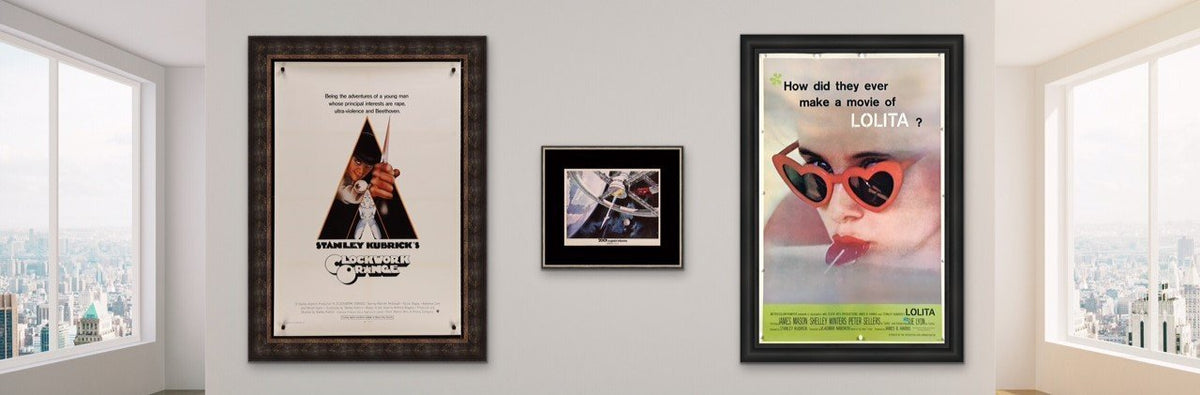
For collectors, these two films show Kubrick at a fascinating turning point: the controlled severity of Paths of Glory on one side, and the grand studio spectacle of Spartacus on the other. You can explore our current original Stanley Kubrick movie posters here.
Tune in next time as Kubrick forms another profitable alliance with a very different screen star: The mercurial Peter Sellers.