FROM THE ART OF THE MOVIES JOURNAL
Stanley Kubrick’s 2001: A Space Odyssey — Through the Stargate

Off the back of Dr. Strangelove, Stanley Kubrick turned his attention from nuclear annihilation to the cosmos, creating a giant landmark of science-fiction cinema. It may well be his masterpiece.
In the early 1960s, the United States and the Soviet Union were locked together in a hazardous stalemate on planet Earth, but the general consensus was that the Soviets had taken an early lead in the space race. Yuri Gagarin had become the first human being to journey into outer space in 1961, and the Americans were under pressure to respond. As a result, President John F. Kennedy threw his weight behind the American space programme and promised to put a man on the Moon by the end of the decade.
Around the same time, Stanley Kubrick was also directing his gaze towards outer space after scoring a timely hit with Dr. Strangelove. His ambition was lofty: teaming up with celebrated science-fiction writer and futurist Arthur C. Clarke, Kubrick sought to create “the proverbial good science fiction movie”.
That might sound a bit snooty, but they had a point. At the time, genuinely great science-fiction movies, particularly hard sci-fi, were thin on the ground. As a genre, it was still very much the realm of bug-eyed aliens and silvery flying saucers — or, as one wit put it, only one rung above pornography on the ladder of social acceptability. The lowly status of cinematic science fiction made what they accomplished even more remarkable.
Much like NASA’s mission to put chunky astronaut boots on the surface of our closest celestial neighbour, making 2001: A Space Odyssey would require vision, imagination, innovation, new technology, daring, and a shedload of money.

As it turned out, Kubrick won the cinematic space race. 2001: A Space Odyssey hit theatres eight months before Apollo 8 took three astronauts on a voyage to the Moon in December 1968. Over the course of the mission, the spacecraft orbited the Moon 10 times without setting down — Apollo 11 would achieve that feat in July of the following year — gathering data and taking stunning photographs including Earthrise, a breathtakingly beautiful image of our blue marble as it appeared above the barren grey surface of the Moon.
Kubrick the visionary seemed to anticipate that feeling of cosmic awe at the beginning of 2001. To the dramatic strains of Richard Strauss’s Also sprach Zarathustra, the Earth rises above the Moon as the Sun also rises beyond our planet: one of the most majestic and awe-inspiring opening scenes ever put on celluloid. The moment, along with later sequences set in space, was a testament to the film’s unprecedented realism.
This authenticity had the unfortunate side effect of inspiring conspiracy theorists to claim Kubrick was responsible for faking the Apollo Moon landings, surely the most depressingly self-defeating myth of its kind. There are plenty of things that suck in day-to-day life, so if you can’t take some sense of wonder and pride from humankind’s first forays into space, then what’s the point?
Anyway, Kubrick’s concept for 2001: A Space Odyssey began with a vague notion that he wanted to make a film about aliens. To this end, he reached out to Clarke to discuss the project. Clarke had moved to Ceylon, now Sri Lanka, to pursue his interest in scuba diving, and Kubrick was apparently convinced that the author was now “a recluse, a nut who lives in a tree.”
By the time they sat down together to talk about it, Kubrick’s goal had expanded into making a film about “man’s relationship to the universe.” Clarke offered him six short stories that might fit the bill. “The Sentinel” particularly piqued Kubrick’s interest.
The story is a pretty simple one. Two explorers discover a crystal pyramid built high in the lunar mountains by an extra-terrestrial civilisation far more ancient than our own. It is protected by an invisible dome, and our crude attempts to blast it open with a nuclear device destroy the structure, cutting off a transmission the pyramid has beamed across space for millions of years.

The tale ends on a note of trepidation as the narrator speculates that the sentinel was essentially an alarm set to alert its builders when intelligent life on Earth has developed enough to take its first steps beyond our planet. Now vastly more advanced beings may be on their way, and their motives might not necessarily be benign.
Together, Kubrick and Clarke fleshed out the idea, with screenplay and novel developing in tandem. The two works would eventually diverge in important ways: Clarke’s novel spells things out in greater detail, while Kubrick’s film takes a more enigmatic, non-verbal approach, trusting images, music and rhythm to do the heavy lifting.
After bouncing around a few tentative titles including Universe, Tunnel to the Stars, and Planetfall, they took inspiration from Homer and settled on 2001: A Space Odyssey, which also neatly encapsulated the film’s main theme of an epic journey. One of the big differences from Clarke’s earlier short story was replacing the pyramidal sentinel with a mysterious black monolith and changing its purpose. Rather than simply operating as a “fire alarm”, the monolith takes a far more active role in the development of our species.
The film opens in pre-history as our earliest ancestors struggle for survival in the wide open spaces of Africa. These guys are prey to predators and there isn’t enough food to support them, co-existing with other foraging creatures without it ever occurring to them to chow down on their flesh for sustenance.
Things change when the tribe awakens to find a featureless black slab standing in their midst. They’re freaked out at first but, after plucking up the courage to touch it, the tribal leader Moon-Watcher — a superb mime performance by Daniel Richter — is struck with inspiration: they can use old bones as clubs to hunt other animals and gain plentiful food.
The tribe also uses its new-found weapons to gain dominance over rivals who have been challenging them for ownership of a watering hole. Cue the most famous match cut in cinema history. Moon-Watcher victoriously hurls his bone-club into the air, and we skip forward four million years from that first tool-weapon to a man-made object orbiting the Earth. Here, 2001: A Space Odyssey dovetails somewhat with Dr. Strangelove, as the innovations that allow us to explore outer space also carry the shadow of destruction. A cautionary approach to technology will soon play another major part in the film.
It’s not all doom and gloom, though, as Kubrick moves on swiftly from our warlike tendencies to a sequence that evokes the finest creative achievements of humankind. As we pan across the Earth, the Moon and the waltzing rhythms of Johann Strauss II’s “The Blue Danube”, we focus on a space station serenely spinning above the planet. A Pan American space shuttle approaches carrying Dr. Heywood Floyd (William Sylvester), on his way to investigate a top secret discovery.

The scene masterfully juxtaposes classical music with pioneering special effects unlike anything cinema-goers had seen before. The former was a happy accident. Kubrick initially commissioned a futuristic original score from Alex North, with whom he had worked on Spartacus. While North was at work, Kubrick used classical compositions as placeholders as he and his team proceeded with the film. Realising the older pieces complemented the visuals perfectly, Kubrick decided to keep them in. Poor old North only found out his efforts had been ditched when he attended the premiere.
As for the special effects, the film was a combination of painstaking research and sheer filmmaking craft. Through Clarke’s scientific contacts and Kubrick’s own relentless pursuit of authenticity, the production drew on advice from scientists, engineers and aerospace companies working at the forefront of space technology. Kubrick insisted on making the technology in the film as scientifically convincing as possible and, with the help of young special effects wizard Douglas Trumbull and a formidable effects team, each spacecraft was designed with meticulous attention to detail.
Good old-fashioned cinematic sleight-of-hand was also employed to create the illusion of weightlessness in space. In Royal Wedding, a lovestruck Fred Astaire tap-dances up the walls of his room and across the ceiling while singing “You’re All the World to Me”, an effect accomplished by fixing the camera and rotating the entire set. Kubrick borrowed this trick to achieve the shot of the Pan Am stewardess walking up to the ceiling in her grip shoes. Making Dr. Floyd’s pen float around the cabin was another simple but effective trick, attaching the writing implement to a pane of glass with double-sided sticky tape and moving it around in front of the camera.
After a little chit-chat at Clavius Base — including a brief appearance by British comedy legend Leonard Rossiter — we find out the reason for Dr. Floyd’s trip to the Moon. Another monolith has been unearthed just beneath the lunar surface. Echoing the earlier scene with Moon-Watcher across the vast ocean of time, Floyd hesitantly touches the smooth surface, causing the monolith to emit a piercing signal aimed at Jupiter.

The meaning of the monoliths is now apparent, at least as much as anything is apparent in 2001: A Space Odyssey. They are placed in strategic positions to kick us along to the next level of technological advancement and evolution. Getting to the Moon is one thing, but a manned mission to Jupiter is still a colossal leap, even decades after the date in the title.
Kubrick foresees the technology that might help us achieve such a feat, however. Next we’re off to the Jovian system aboard Discovery One. Our friendly AI supercomputer HAL 9000 (voiced by Douglas Rain) is in charge of most of the spacecraft’s functions while Dr. Dave Bowman (Keir Dullea) and Dr. Frank Poole (Gary Lockwood) keep the lights on as their colleagues slumber in suspended animation.
Discovery One features yet another gobsmacking piece of production design. Kubrick’s team built a full-size version of the centrifugal living quarters at MGM-British Studios in Borehamwood. With Gary Lockwood strapped into his seat, the whole “hamster wheel” set could be rotated around a fixed camera to create the startling illusion of Poole jogging around the entire interior before joining his colleague at a table.

The Discovery sequence is the only part of the film that resembles a conventional dramatic narrative, and it’s a cracker. When HAL reports the failure of an external antenna unit, it appears that the supposedly infallible supercomputer has made a mistake. The glitch seems to throw HAL into an existential crisis, first attempting to blame the situation on human error before leaping to a more deadly conclusion. Realising Bowman and Poole plan to shut him down, HAL decides to remove the human element from the mission by killing all the crew members.
With his baleful red eye scrutinising every action of his would-be victims and Rain’s hypnotic voice, HAL is one of the great movie villains. Curiously, he’s also the only character in the film who displays anything resembling ordinary human reactions. While the scientists are flat and emotionless, we can detect a range of feelings in HAL’s otherwise monotone voice: pride, confusion, disapproval, threat, placation, and finally fear as he pleads with Bowman not to shut him down.
Whether HAL is truly sentient is left to us to decide, but it is strangely moving to hear him singing “Daisy Bell” as he loses his faculties one by one. The song was not chosen at random: Arthur C. Clarke had heard an early Bell Labs demonstration of computer-synthesised singing, giving HAL’s final performance a neat historical echo as well as a horribly poignant one.
HAL’s malfunction raises questions about how much control we humans should hand over to our supercomputers, a concern that becomes more pertinent every year as tech companies race to develop increasingly advanced AI. In the context of the film, it’s another example of how Kubrick and Clarke evidently viewed technology as a double-edged sword.
On one hand, HAL is one of the advancements that enables us to reach Jupiter and find the next monolith. On the other, what would happen if he managed to wipe out the entire crew? Presumably the enormous slab floating above the gas giant only works when it comes into contact with humans, so if HAL’s psychotic plan succeeded, it might have scuppered the next stage of evolution.

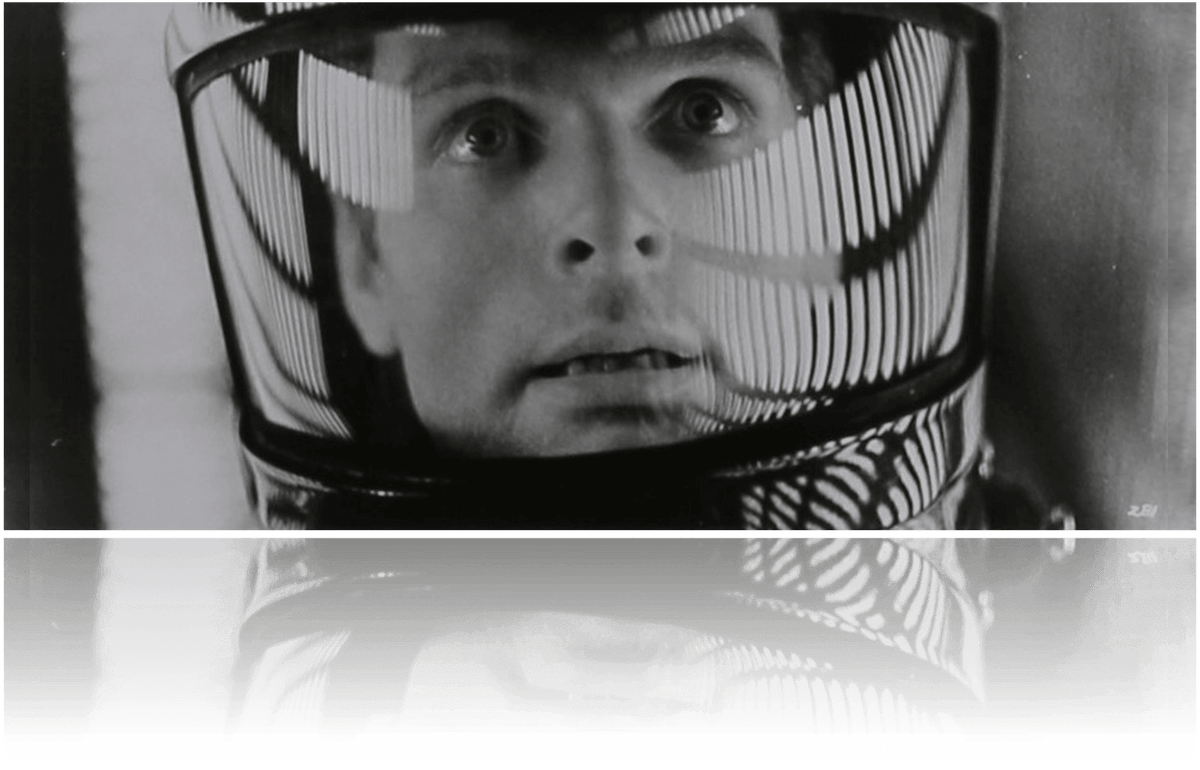
After the most traditional movement of 2001: A Space Odyssey, we take a dive into its most abstract. With everyone else dead and HAL safely defunct, Bowman leaves Discovery One in an EVA pod to check out the third monolith. As he does so, it turns into a stargate and we spend the next few minutes watching a trippy light show as he is transported to an unknown part of the universe.
When he gets there, he spends the rest of his natural life in a recreated hotel room, perhaps plucked from his mind by his mysterious alien hosts to make him feel a bit more at home. We see him as an ageing gentleman, who in turn sees his elderly self on his deathbed. A fourth and final monolith appears to a frail and dying Bowman, completing his transformation. Cut to Bowman as the Star Child, a giant foetal being in a glowing sphere approaching planet Earth.
There was some discussion between Clarke, Kubrick and Carl Sagan about how best to represent an alien species. Some design work went ahead to create our enigmatic benefactors, but Kubrick wisely decided it was best to leave the extra-terrestrials to our imagination. No matter how good the special effects are in the film, seeing the aliens would no doubt have cheapened the overall tone.
The ending is deliberately ambiguous. Presumably Bowman, now reborn as a higher form of life, has come home to elevate the whole human race into the same state, but to what end? I like to think that if we ever reached a post-human state, we’d transcend the worst aspects of our earthly nature and become a positive force, exploring the universe for eternity and perhaps helping less advanced species along the way. The return of Also sprach Zarathustra makes the ending feel inspirational rather than merely strange; the use of classical music throughout the film showcases what we can achieve when we’re not trying to destroy each other and our home planet.

2001: A Space Odyssey was not an instant, uncomplicated success when it was first released in 1968. The budget had ballooned to over $10 million, MGM was nervous, and critics were divided. While the film received plenty of positive reviews, some naysayers called it “unimaginative” and “boring.” Famously, Rock Hudson walked out of the Los Angeles premiere muttering: “What is this bullshit? Will somebody tell me what the hell this is about?”
Younger audiences tended to respond better, drawn by their intense interest in the space programme and the film’s psychedelic imagery as they smoked their “funny cigarettes,” according to Keir Dullea. Consequently, the studio leaned into the countercultural crowd with new promotional material that sold the movie as “the ultimate trip.”
As for Stanley Kubrick, he dismissed the harshest critics as “dogmatically atheistic and materialistic and earthbound.” He wasn’t wrong, but you can also see why some people didn’t get it. Audiences simply hadn’t seen anything like it, and I’d argue that we still haven’t seen anything to match it since. I even understand why some folks find it boring. Frankly, it’s not the kind of movie I’m going to reach for if I want something to go with a few beers and a pizza on a Friday night. It’s not even my go-to Kubrick film if I’m in the mood for something Kubricky — my favourite is still to come in this series.
But 2001: A Space Odyssey is a film that I admire deeply and appreciate more than almost anything else in cinema. It trusts the viewer’s intelligence, refusing to spell things out. It moves at its own majestic pace, containing immense spaces that allow time for thought, interpretation and meditation. I often compare it to watching an orchestra performing a classical piece. You don’t go to a concert hall to rock out to Beethoven or Bach or Mozart. You go to sit quietly and listen, allowing the music to wash over you and transport you, stirring the mind and buoying the soul, perhaps revealing things about yourself that you didn’t know before.
Kubrick saw art as a way of seizing control in our short time on planet Earth and making the very most of it. He said:
“The most terrifying fact about the universe is not that it is hostile but that it is indifferent; but if we can come to terms with this indifference and accept the challenges of life within the boundaries of death — however mutable man may be able to make them — our existence as a species can have genuine meaning and fulfilment. However vast the darkness, we must supply our own light.”
Kubrick was sometimes viewed as a cold and dispassionate sceptic, but 2001: A Space Odyssey is the purest distillation of his viewpoint that “the very meaninglessness of life forces man to create his own meaning.” That doesn’t need to be the depressing thought it may seem at first glance. On the contrary, 2001 is a film that encourages us to contemplate our own existence against the endless backdrop of the universe and feel a sense of wonder and awe.
It’s a landmark masterpiece that has transcended cinema and become a towering testament to what we have in ourselves to achieve. You can’t ask any more of a film, or indeed any work of art, than that. And it’s perhaps the single most compelling reason why, in a career brimming with classic after classic, Stanley Kubrick is so revered.

For collectors, 2001: A Space Odyssey also occupies a special place in movie poster history. Its campaign imagery had to sell something audiences had never really seen before: not just spaceships and spectacle, but mystery, scale and a sense of the infinite. You can explore our current original Stanley Kubrick movie posters here.
In the next part of our Kubrickathon, the director gets all cynical on us as he offers two very different literary bad boys.