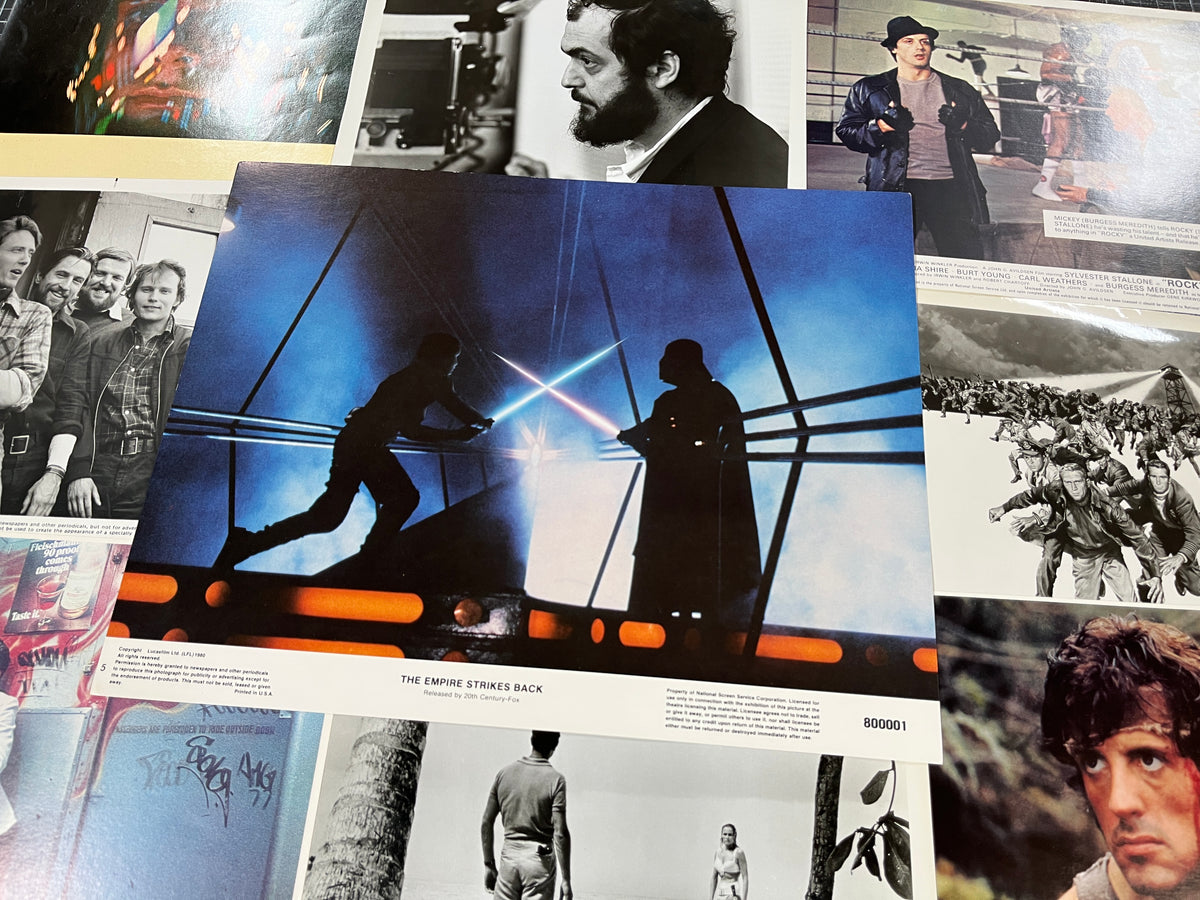
FROM THE ART OF THE MOVIES JOURNAL
From Printer to Cinema: The Working Life of an American Movie Poster

We spend a lot of time looking at the artwork on movie posters.
Quite right too!
But next time you have an old American One Sheet in front of you, take a look right at the bottom. Somewhere among the studio credits, copyright notices and other tiny print, there is a good chance that you will find a number.
On our original 1959 U.S. One Sheet for Porgy and Bess, that number is 59/218.
There is something else down there too.
In extremely small type at the lower left, it reads:
Property of National Screen Service Corp. Licensed for display only in connection with the exhibition of this picture at your theatre. Must be returned immediately thereafter.


Now that is interesting.
Here is a beautiful piece of original movie advertising, produced for one of the major films of 1959, and the cinema showing it is being told very clearly that the poster is not theirs.
It belongs to the National Screen Service.
They can put it up while they are showing the film.
And then the NSS wants it back.
We see NSS numbers on American movie posters all the time. To collectors they are incredibly useful for identifying different releases and re-releases. Originally, though, they were part of something much bigger: the system that helped manufacture, identify, store and distribute movie advertising across the United States.
So, what actually happened to an American movie poster after it was printed?
How did it reach the cinema?
And why on earth did somebody want it back afterwards?
A Lot of Work to Sell One Movie
Long before the NSS came to dominate the business, American cinemas were already being supplied with a bewildering array of advertising.
The industry called these things accessories.
That rather unexciting word covered One Sheets, Three Sheets, Six Sheets, Inserts, window cards, lobby displays, 8 x 10 stills and, at the enormous end of the scale, Twenty-Four Sheets.
A surviving United Artists campaign book for Mary Pickford's Sparrows gives us a wonderful glimpse of what ordering all of this looked like in 1926.

The local United Artists exchange could supply the accessory order form.
A One Sheet was listed at 12 cents, a Three Sheet at 36 cents, a Six Sheet at 72 cents and a huge Twenty-Four Sheet at $2.
Want the trailer? That came directly from the National Screen Service.
Two-colour heralds - small handbills that could be distributed locally - came from Longacre Press in New York.
Need a quantity of Mary Pickford portrait photographs? Stern Photo Advertising could help with those.
Longacre would even send the heralds parcel post 'cash on delivery'.

United Artists’ 1926 campaign book for Sparrows, showing the range of advertising accessories available to exhibitors - from One Sheets and Three Sheets to enormous Twenty-Four Sheets - together with their listed prices.
The cinema owner had a lot to do for just one film!
There is an interesting wrinkle in those poster prices.
Read the order form on its own and it looks very much like an ordinary purchase. Pick your posters, add up the cost and send the money.
But the amount charged for an advertising accessory did not necessarily mean that the cinema became the outright owner of the paper. The industry used different distribution, rental and licensing arrangements, and the campaign books did not always spell those terms out next to the price list.
That becomes much more obvious later, when posters such as our Porgy and Bess actually carry the instruction that the material remains the property of the NSS and must be returned after the cinema has finished showing the film.
It is easy to imagine movie publicity as something created centrally by a studio and then somehow appearing at the cinema. In reality, an exhibitor could find himself dealing with several suppliers before he had everything needed for a decent campaign.
There was another option too.
Independent businesses known as poster renters kept stocks of movie advertising from a number of film companies. Instead of dealing separately with every studio exchange, a cinema could obtain much of what it needed from one local supplier.
It was a useful enough service that, by 1940, there was at least one poster renter operating in almost every American film-exchange area.
And among all those companies supplying bits and pieces to cinemas in the 1920s was a name that is going to become rather important.
The National Screen Service.
Enter the NSS
The NSS had started with trailers.
By 1939 it had grown into a substantial national business. A Film Daily profile from that year lists offices in Chicago, Los Angeles, Dallas, Seattle, Atlanta, Minneapolis, Boston, New Orleans, Cleveland and Detroit, among others, and describes an exchange network of 23 units across 21 cities.
That is before it took control of the major studios' standard poster distribution.
Paramount provided the big opportunity.
Its own poster operation was proving expensive and difficult to run, particularly when demand for advertising material could be so unpredictable. A successful film might require more posters for longer than expected. A flop could leave a lot of suddenly unwanted paper sitting in warehouses around the country.
In December 1939 Paramount signed an agreement with the NSS.
The National Screen Service would manufacture and distribute Paramount's standard advertising accessories, maintain branches wherever Paramount operated film exchanges and take over the studio's existing accessory stock.
RKO followed in 1940, and Loew's in 1942.
Then, over the next few years, the remaining major studios gradually moved their standard advertising business across too: Universal in 1944, Columbia in 1945, United Artists and Warner Bros. in 1946, and finally 20th Century-Fox in 1947.
In less than a decade, an industry that had once been handled separately by the major studios had been transformed.
By 1947, the NSS sat at the centre of an extraordinary amount of American cinema advertising.
There is a small but important distinction here.
The NSS printing the poster did not necessarily mean that it had designed it.
Under its 1942 agreement with Loew's, for example, the studio supplied completed artwork and still negatives from which the NSS could produce the finished advertising material.
So behind one apparently simple sheet of paper there could be a studio publicity department, artists and designers, printers, NSS warehouses, local exchanges and finally the cinema itself.
Which brings us back to that number.
What on Earth Is 59/218?
For anybody interested in original American movie posters, NSS numbers can become slightly addictive.
Once you know where to look for them, you start looking for them everywhere.
The numbering system helped the NSS control the production, distribution and storage of its trailers and advertising accessories. Research by film accessory researchers Ed and Susan Poole has brought together thousands of surviving examples alongside original NSS records, including a trailer log covering 1930 to 1962 and a 1962 Master Index.
Our Porgy and Bess carries 59/218.

The 59 places it in the NSS series for 1959, while 218 identifies the title within that series.
It does not mean that this is poster number 59 from a print run of 218.
And it isn't quite as simple as saying that Porgy and Bess was the 218th film released that year either. Studios sent jobs through to the NSS in batches, so the surviving numbering sequence has some wonderful oddities.
There is another useful thing to know about these numbers too.
An original American movie poster does not have to carry one.
Our archive includes this original 1985 U.S. One Sheet for Back to the Future, featuring Drew Struzan's now iconic artwork.

It is a genuine original theatrical poster. It was printed in the U.S.A., carries the expected studio and production credits and, along the bottom edge where you might expect to find an NSS reference, there isn't one.
Other original Back to the Future One Sheets are known carrying the NSS reference 850064.
That makes the film a particularly useful example. Genuine original posters for the same campaign can exist both with and without the familiar NSS numbering.
Collectors often describe non-NSS examples like this as studio issued, although the terminology is not always used consistently. What matters is that the absence of an NSS number is not, by itself, evidence that a poster is a reproduction or a fake.
It is one clue among many: dimensions, printing, credits, paper, known variants and provenance all matter too.
And an independent poster exchange does not automatically mean non-NSS paper either. Once the NSS had taken over the major studios' accessory business, some independent poster renters obtained their stock from the NSS under sublicence. A poster could therefore reach a cinema through an independent exchange and still carry an NSS number.
Which brings us to another numbering curiosity - and one of our favourites.
It involves a boxer from Philadelphia.

Rocky opened in New York in November 1976 and began its wider U.S. release in December.
Look at the bottom right of its original U.S. One Sheet, however, and you find:
77/2

One of the very first NSS numbers of 1977 on a film already in cinemas during 1976.
There is an intriguing possible explanation.
Producers Robert Chartoff and Irwin Winkler later recalled having to persuade United Artists to release Rocky in time for Academy Award consideration. That makes it quite possible that the advertising campaign had already entered the NSS system as a 1977 release before the decision was made to put the film into cinemas during the closing weeks of 1976.
We haven't found the United Artists or NSS paperwork that confirms a change of plan, so 77/2 cannot prove it.
But it is a fascinating little clue.
At the very least, it shows why an NSS number shouldn't be treated as a simple record of a film's theatrical release date. And perhaps, in this case, it preserves a trace of Rocky being brought forward rather later than originally intended.
Nearly fifty years later, it is exactly the sort of tiny detail that makes these posters so fascinating to study.
Posters, Police and a Professional Weight-Guesser
Once the NSS had the poster in its system, the next person who mattered was the cinema manager.
And the surviving pressbooks are fantastic.

The 1946 British thriller Green for Danger was released in America by United Artists and its exhibitor campaign book contains all sorts of ideas for persuading the public to come and see it.
There are newspaper campaigns, lobby displays, fashion promotions and suggestions involving the local police.
There is even a recommendation that the cinema employs a professional weight-guesser.
Apparently there were people who did this.

The idea was to tie the stunt to a line from the film about guessing somebody's weight and turn it into a competition outside the theatre. Quite how many murder-mystery tickets were sold as a result is sadly not recorded.
Among all this magnificent 1940s promotional enthusiasm is the rather more practical information the cinema needed.
The stills, advertising mats and accessories shown in the pressbook were to be ordered from the nearest National Screen Service exchange.
The trailer came from the NSS too, and exhibitors were encouraged to start running it during the week before the film arrived.

United Artists’ 1946 campaign book for Green for Danger, directing exhibitors to order the film’s advertising material from the National Screen Service.
You find the same system years later.
The pressbook for Alfred Hitchcock's The Birds, released in 1963, directs cinemas to their local NSS exchange for trailers, slides, advertising mats, colour gloss stills and other material.
A cinema wasn't necessarily sent one standard box containing everything. The campaign books offered choices. An exhibitor could decide which posters, stills and other pieces of advertising suited the theatre and how heavily it wanted to promote the film.
Then somebody had to put it all up.
Period photographs of American cinemas can be glorious things: marquees blazing with lettering, One Sheets in display cases, huge sheets covering walls and smaller stills filling the lobby.

Children outside a Chicago movie theatre on Easter Sunday, April 1941, with current film advertising on display behind them. Photograph by Edwin Rosskam, Library of Congress.
This was where the poster earned its keep.
A Working Piece of Paper
We have an original 1971 U.S. One Sheet for Evel Knievel that is still folded and has a couple of pinholes.

Another poster in the collection, The Lost World of Sinbad, has folds, creasing and evidence of old tape around the edges.

It is tempting to look at things like that entirely through twenty-first-century collector eyes.
Pinholes. They must be bad.
Tape. That must definitely be bad.
Folds. Depends who you ask!
But these weren't produced as limited-edition art prints. They were working pieces of advertising: intended to be stored, shipped, unfolded, displayed, taken down and, sometimes, put to work again somewhere else.
That doesn't tell us who put the pinholes in our Evel Knievel, or where. But it does put them in a rather more understandable context.
Some movie posters have had a busy life.
Others appear to have done very little at all.
Our 1979 U.S. re-release One Sheet for Disney's Sleeping Beauty, for example, has never been folded and survives in wonderful condition.

All three are original movie posters.
They have simply arrived here by very different routes.
Did They Really Put the Posters in the Film Cans?
We have heard - and relayed - this story many times.
American movie posters were folded because they had to fit inside the film cans with the reels.
It is a lovely story.

Inside an American cinema projection booth, February 1958. Photograph by Marion S. Trikosko, Library of Congress, U.S. News & World Report Magazine Photograph Collection.
You can picture a projectionist opening the can, taking out the reels and finding the poster packed neatly inside ready to go on display.
The problem is that there doesn't seem to be good evidence that this is why One Sheets were folded.
There is a historical connection that probably helps explain how the story arose. In the earlier studio-exchange system, the film and its advertising accessories could indeed be supplied through the same exchange. As films moved through successive cinema runs, the advertising moved through that world too.
But “the poster travelled with the film” and “the poster was folded to fit inside the film can” are not quite the same thing.
There is perhaps a wonderfully boring explanation.
A U.S. One Sheet of this period typically measures around 27 x 41 inches.
Try filing a few thousand of those flat.
Fold them and the problem becomes considerably easier.
Our Porgy and Bess is an interesting example because it doesn't even have the standard horizontal-and-vertical folding pattern most collectors expect. It was folded twice horizontally but not through the vertical centre.
So, was the One Sheet folded because it needed to fit in a film can?
Perhaps someone will uncover the studio or NSS paperwork that proves it one day.
For the moment, the film can remains a very good story.
And Then They Wanted Them Back
Once the film had finished playing at the cinema, a National Screen Service poster could still have plenty of work left to do.
Films moved through successive theatrical runs. A picture might begin at a first-run theatre before moving, after the required clearance period, to later-run cinemas elsewhere in the same market and beyond.
The advertising could circulate too.
The evidence for this is unusually good. In the 1950s, a group of independent poster-rental businesses took the National Screen Service to court, accusing it of restricting competition in the movie-advertising trade. Because the case turned on how that trade actually worked, the resulting judgements preserve a remarkably detailed account of how the business operated.
One of them, the 1959 Lawlor v. National Screen Service Corp. judgement, spells out that the same movie advertising accessories could be used repeatedly by different exhibitors.
Suddenly the notice on Porgy and Bess makes perfect sense.
Must be returned immediately thereafter.

The cinema wasn't necessarily receiving something it would keep forever. It was using advertising stock for the period in which it was showing the film.
When the engagement finished, the poster could return to the system and be supplied again while another exhibitor still had a use for it.
That is a very different way of thinking about an original movie poster.
Today we tend to ask which cinema a poster “came from”, as though it must have belonged to one theatre for its working life.
Some undoubtedly did.
But during the NSS era, a poster could have been part of a much larger pool of paper moving around the country.
To the cinema staff taking it down, this wasn't a future collectible. It was advertising stock that still had a job to do elsewhere.
What Happens When Nobody Wants Porgy and Bess Any More?
There is an obvious flaw in building enormous warehouses full of advertising that can only be used to promote one particular film.
Eventually the telephone stops ringing.
A successful picture might play for years through different theatrical runs and reissues. Others disappeared from cinemas far more quickly.
Either way, once there was no demand for a title, its posters weren't much use to the NSS.
The problem was recognised by the industry itself. One of the risks of the accessory business was simply that stock became obsolete.
Imagine the quantities involved after several decades.
The surviving NSS records used by Ed and Susan Poole show an organisation maintaining vast title inventories over many years. By the 1980s the business was shrinking, offices were closing and old poster stocks were being sold.
That is one of the ways original movie posters began to leave the industry that had created them and enter the emerging collector market.
Not the only way, of course.
Cinemas kept things. People who worked in cinemas kept things. Independent poster exchanges had their own stocks. Studios retained material. Some posters simply took routes that nobody recorded and nobody now remembers.
And perhaps that is the nicest thing about these surviving posters.
The folds, pinholes, tape marks, NSS numbers and tiny instructions along their bottom edges are not distractions from the artwork.
They are part of the story.
They remind us that an original movie poster was never intended to spend its life carefully stored in an archive or framed on a collector's wall.
It was made to work.
Somehow, decades later, a few of them are still here to tell us how.
Our sources and some acknowledgements
Much of what we know about the mechanics of the American movie-poster trade comes from an unusual source: the antitrust cases brought against the National Screen Service. In particular, the 1959 judgement in Lawlor v. National Screen Service Corp. records the earlier studio-exchange and poster-renter system, the reuse of advertising by successive exhibitors, the early studio contracts with the NSS and the wording of the company's ownership notice.
The later Poster Exchange, Inc. v. National Screen Service Corp. judgement provides further detail on the studio-by-studio growth of the NSS's standard-accessory business during the 1940s.
We also consulted original exhibitor material including United Artists' 1926 campaign book for Sparrows, the 1946 Green for Danger pressbook and later studio campaign material, together with the contemporary 1939 Film Daily Cavalcade account of the National Screen Service.
For NSS numbering and the company's surviving records we are indebted to Ed and Susan Poole's National Screen Service Poster & Accessories Number Log, compiled from thousands of surviving movie posters and original NSS material including its 1930-1962 trailer log and 1962 Master Index.
For the unusual 77/2 numbering on Rocky, we also consulted the American Film Institute's release chronology and later recollections by producers Robert Chartoff and Irwin Winkler concerning their efforts to secure a late-1976 release in time for Academy Award consideration.
All poster images come from the Art of the Movies archive and are of original movie posters. Our Back to the Future example is a genuine 1985 U.S. One Sheet without an NSS number; other original examples of the same Drew Struzan campaign are known with the NSS reference 850064.